




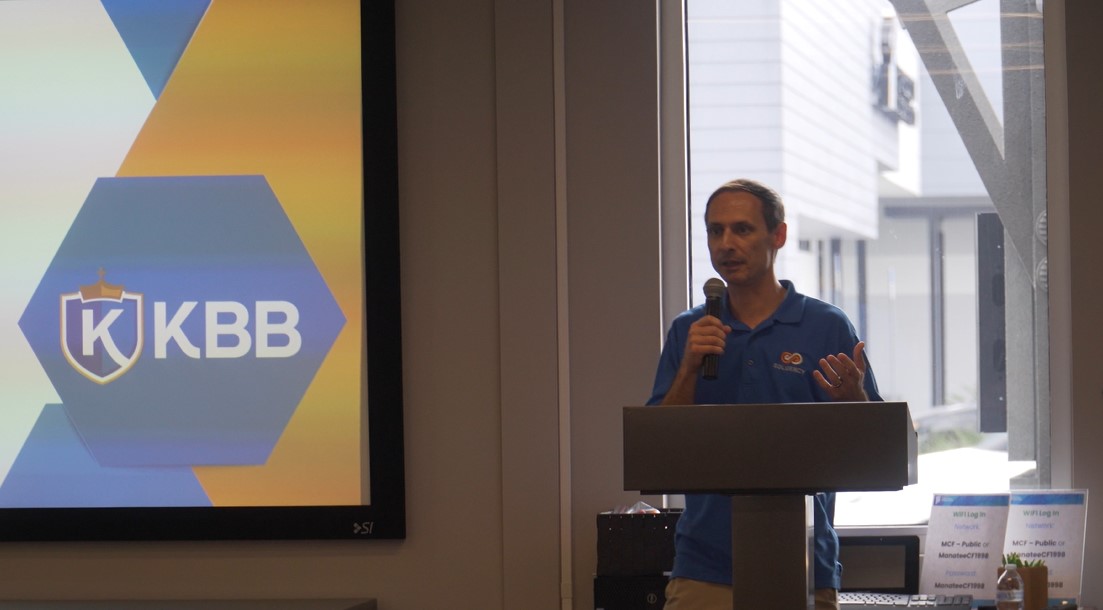
We’re looking forward to introducing you to Robert Lederhilger III. Check out our conversation below.
Good morning Robert, we’re so happy to have you here with us and we’d love to explore your story and how you think about life and legacy and so much more. So let’s start with a question we often ask: What are you being called to do now, that you may have been afraid of before?
I’m being called to start a regenerative farm with my wife called Restore Creation and that’s something I never would have imagined saying a few years ago.
Neither of us comes from farming backgrounds. If you had asked us then, we wouldn’t have described ourselves as people who work the land. I don’t like bugs or snakes, and the idea of becoming a “farmer” simply wasn’t part of how I understood my future. It felt unfamiliar, impractical, and honestly a little intimidating.
What changed wasn’t a single moment, but a convergence. My wife and I each felt a similar pull independently—toward stewardship, toward building something rooted and life-giving, toward participating more directly in creation rather than just managing systems from a distance. Over time, those individual stirrings became a shared conviction. When we finally talked about it together openly, it became clear that this wasn’t just an idea—it was a calling we were meant to step into together.
As I’ve begun to embrace that calling, my perspective has shifted. Things that once felt like obstacles now feel like part of the work itself. I’m learning how to engage with the land, planting and experimenting where I can, even before we officially have property of our own. The fear hasn’t completely disappeared, but it no longer defines the decision. Curiosity, humility, and responsibility have taken its place.
We don’t have land yet, but we are actively looking. In the meantime, the work has already started—internally and practically. Saying yes to this calling has meant letting go of a narrow definition of who I thought I was allowed to become, and trusting that obedience sometimes precedes clarity.
Can you briefly introduce yourself and share what makes you or your brand unique?
I’ve been a serial entrepreneur for as long as I can remember. Even as a kid, I was always starting ventures, finding problems, experimenting with ideas, and trying to build systems that worked better than what already existed. That instinct carried into adulthood and eventually became my career.
Today, I’m the founder of SOLUENCY, a technology company that operates across several layers of the digital stack. We do custom app development, managed hosting, and infrastructure, and we also build practical tools for small businesses like NFC smart business cards and automation systems. Most recently, we’re launching VITAL, an AI-powered virtual employee designed to help small businesses handle calls, texts, follow-ups, and customer engagement 24/7/365 without needing to hire additional staff. At its core, SOLUENCY is about designing systems that reduce friction and allow people to focus on higher-value work.
Alongside my business work, I’m also involved in Kingdom Business Builders, which functions similarly to a chamber of commerce but with a very different foundation. Instead of networking events, we gather around Bible studies and intentional conversations about faith, work, and leadership. Our long-term vision is to use the organization to support justice-impacted individuals by helping them start businesses of their own or find meaningful employment through member businesses. It’s about restoring dignity, opportunity, and purpose through community and entrepreneurship.
More recently, my wife and I have begun pursuing Restore Creation, a regenerative farming initiative focused on stewardship of the land and producing healthy food. While it may look unrelated to technology or business on the surface, it’s actually driven by the same curiosity I’ve always had: how systems function when they’re designed well, cared for properly, and allowed to operate as intended.
Because all of these pursuits once felt disconnected, I recently started a blog called Systems & Soil. It’s my attempt to tie everything together—technology, entrepreneurship, faith, land, and responsibility—and to explore the common principles that show up whether you’re building software, organizations, or ecosystems. At this stage of my life, I’m less interested in isolated success and more interested in building things that are integrated, resilient, and meaningful.
Great, so let’s dive into your journey a bit more. What part of you has served its purpose and must now be released?
The part of me that has served its purpose is the version of myself that believed my value was primarily expressed through building, optimizing, and staying one step removed from the systems I designed.
That mindset was necessary for a long time. It’s what allowed me to become a serial entrepreneur, to build companies, to work comfortably in abstraction and complexity, and to solve problems at scale. I learned how to see patterns, reduce friction, and make systems work when they otherwise wouldn’t.
But over time, I began to see its limitations. When everything is treated as a system to be optimized, it becomes easy to place responsibility somewhere else. You can design structures without ever fully participating in them. You can remain productive while staying insulated from the kind of dependence, risk, and humility that certain forms of work require.
What I’m releasing now is the need to remain detached. I’m making space for a more embodied form of responsibility—one that values stewardship over efficiency. That shift is part of what’s drawing my wife and me toward building Restore Creation, and why I started writing through Systems & Soil. I’m less interested in standing outside the system and more interested in being rightly placed within it.
Letting go of that former identity doesn’t mean abandoning my talents. It means allowing those skills to serve something deeper. Some work can’t be abstracted, automated, or optimized away—and learning to stay present with that kind of work has become the next step of my calling.
When did you last change your mind about something important?
I changed my mind fairly recently about what meaningful work actually looks like.
For most of my life, I believed good work was defined by outcomes you could measure. If something scaled, reduced friction, or produced visible results, it counted. If it made money, it was good. That framework served me well as a serial entrepreneur. It helped me build companies, solve complex problems, and operate comfortably in abstraction. I assumed that if the system worked and generated revenue, the work itself was worthwhile.
What I’ve changed my mind about is the idea that outcomes and revenue are the most important measures. I’ve come to see that work and life can’t be evaluated solely by results. It’s also about people: who the work serves, who it forms, and who it leaves behind.
That realization has influenced nearly everything I’m working on now. It’s part of why my wife and I are pursuing Restore Creation, where progress is slower, more physical, and inseparable from daily participation. It’s also why I started Systems & Soil, as a way to think through how the same principles apply across technology, business, faith, and land.
I haven’t abandoned systems thinking or ambition. I’ve just changed my definition of success. Instead of asking whether something works at scale, I’m asking whether it benefits the people involved and whether it’s something I’m willing to live inside for the long term.
I think our readers would appreciate hearing more about your values and what you think matters in life and career, etc. So our next question is along those lines. What would your closest friends say really matters to you?
They’d say I value responsibility and stewardship. I take seriously the idea that whatever you’re entrusted with—whether it’s a business, a relationship, a community, or land—you’re accountable for how you care for it and the people affected by it. I don’t like shortcuts that produce results at the expense of integrity or people.
They’d also say that faith matters to me, not as a label but as something that shapes my decisions. I care about building things that honor God and serve others, even when that makes the path slower or less obvious. That shows up in my work, in my friendships, and in the kinds of projects I choose to pursue.
And finally, they’d probably say that I care about building things that last—systems, businesses, and relationships that are resilient and meaningful, not just impressive. I’m less interested in optics and more interested in whether something is healthy, honest, and worth standing behind long term.
Thank you so much for all of your openness so far. Maybe we can close with a future oriented question. What are you doing today that won’t pay off for 7–10 years?
My wife and I are building Restore Creation with a timeline that is very intentionally measured in decades, not quarters. The vision itself takes seven to ten years to fully come to life.
We’re designing a regenerative permaculture farm built around perennial food systems—trees, soil, and animals that need time to mature. Fruit and nut trees take years before they produce meaningful yields. Livestock systems take time to stabilize as animals reproduce, genetics improve, and the land itself recovers and strengthens. None of this can be rushed without compromising the health of the system.
From the beginning, our goal is to operate without outside inputs as much as possible. We want the animals to be fed from what the land produces, not from trucked-in feed. We want fertility to come from compost, rotation, and biological processes rather than chemicals. That requires patience, careful planning, and a willingness to let natural systems do what they were designed to do over time.
The long-term vision is to support a subscription-based food model—providing families with consistent access to healthy meat, fruit, and produce grown responsibly. But that kind of trust and reliability only comes once the land, the systems, and the rhythms are well established. You don’t build that in a year or two. You earn it slowly.
Restore Creation is a commitment to staying put long enough for the trees to grow, the animals to multiply, and the land to become more resilient year after year. The payoff isn’t immediate, and it isn’t only financial. It’s the kind of work where the real return shows up later—in soil health, food quality, community trust, and the knowledge that we built something designed to outlast us.
Contact Info:
- Website: https://systemsandsoil.com
- Linkedin: https://www.linkedin.com/in/robertlederhilger
- Facebook: https://www.facebook.com/Soluency/
- Other: https://www.robertlederhilger.com/
Image Credits
Robert W. Lederhilger III